Public transit is much faster with a bike
by Nejat Can · 3 min read ·
For most commuters, driving is faster. The average U.S. commute takes 27 minutes by car but 50 minutes by transit1. It’s not surprising that 90% of in-person workers drive while only 4% take public transit1. People have a high preference for the fastest way of getting around.
In New York City, transit is faster than driving. Traffic in Manhattan’s central business district averages 7.1 mph2 while the subway averages 17.4 mph3. As a result, 75% of Manhattan commuters travel by transit, and only 14% drive4. Cost, safety, and convenience also matter. But time matters the most5,6.
In the Bay Area, commute patterns look more like the U.S. and less like Manhattan – 83% of in-person workers drive7. But cars come at a tremendous cost to society. Cars kill people, poison the air, warm the planet, eat the land, and make streets loud and ugly. Society tolerates this for fast travel. If we want people to drive less in San Francisco, we must make alternatives to driving faster. We need a solution today, without the decades-long wait for new rapid transit.
The solution is combining cycling with public transit. When I visit my brother at Stanford, transit takes 2 hours 4 minutes. Bringing a bike cuts it to 1 hour 16 minutes. This speedup is possible because Caltrain, like all rapid transit, is fast – but getting to and from it isn’t. Biking solves that inefficiency.
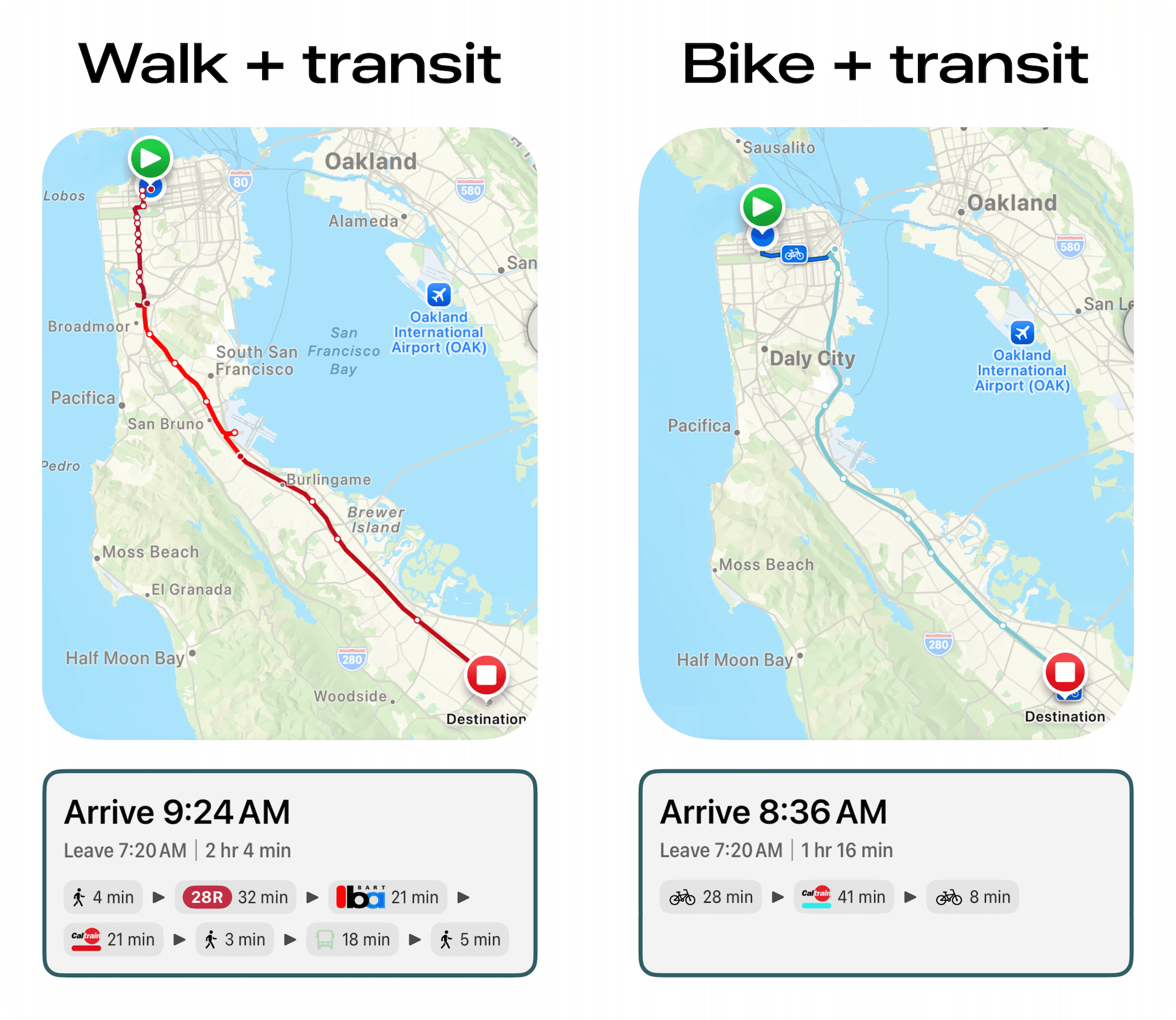
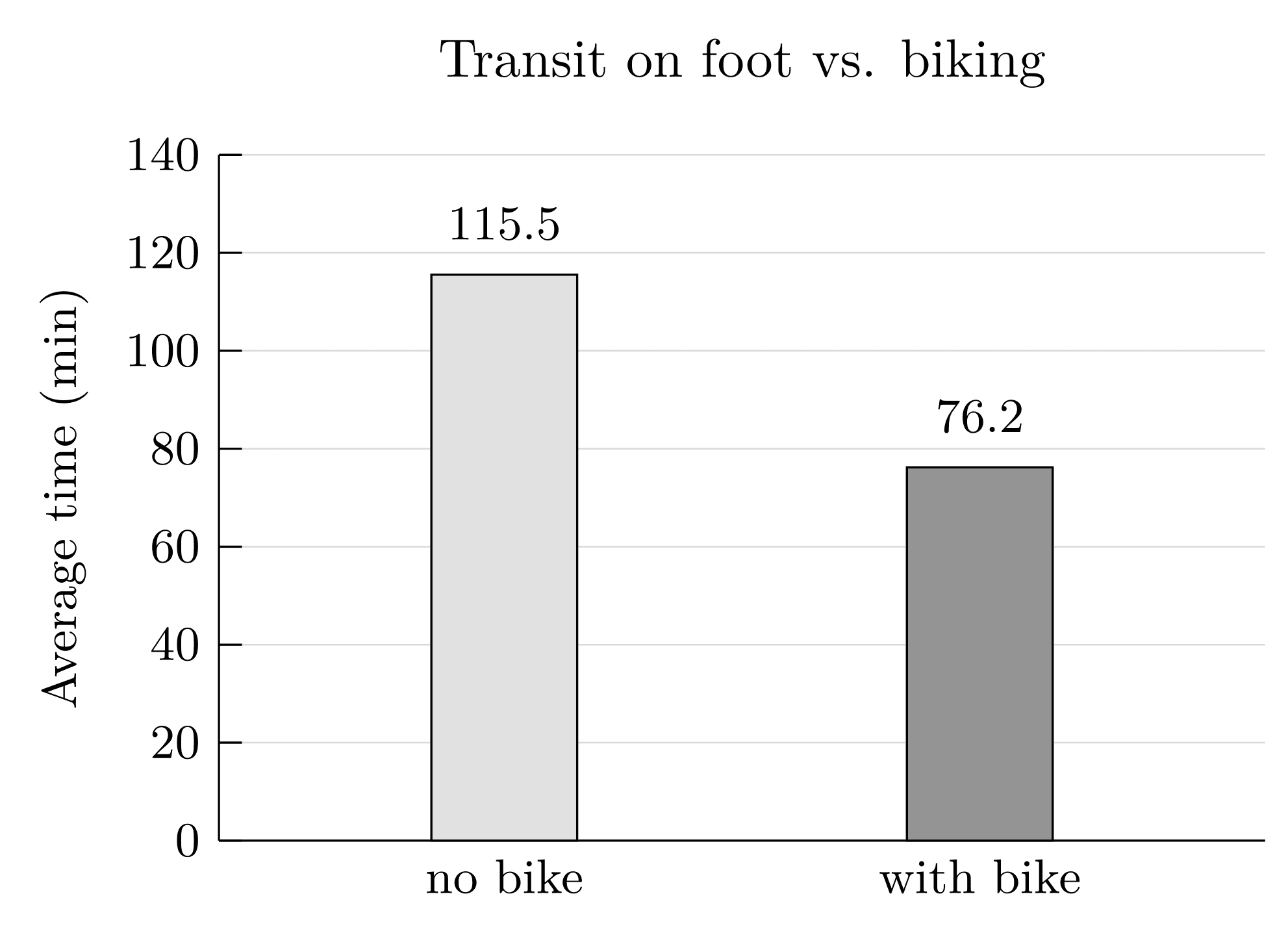
This is not an anomaly. I randomly sampled 10,000 origin-destination pairs weighted by population density. For each pair I set a departure time of 5:00 p.m. on a weekday and routed it with Modemix, a navigation app I built.
Walking to transit averaged 116 minutes. Biking to transit averaged 76 minutes. Simply biking to transit instead of walking is 52% faster, saving 40 minutes on average.
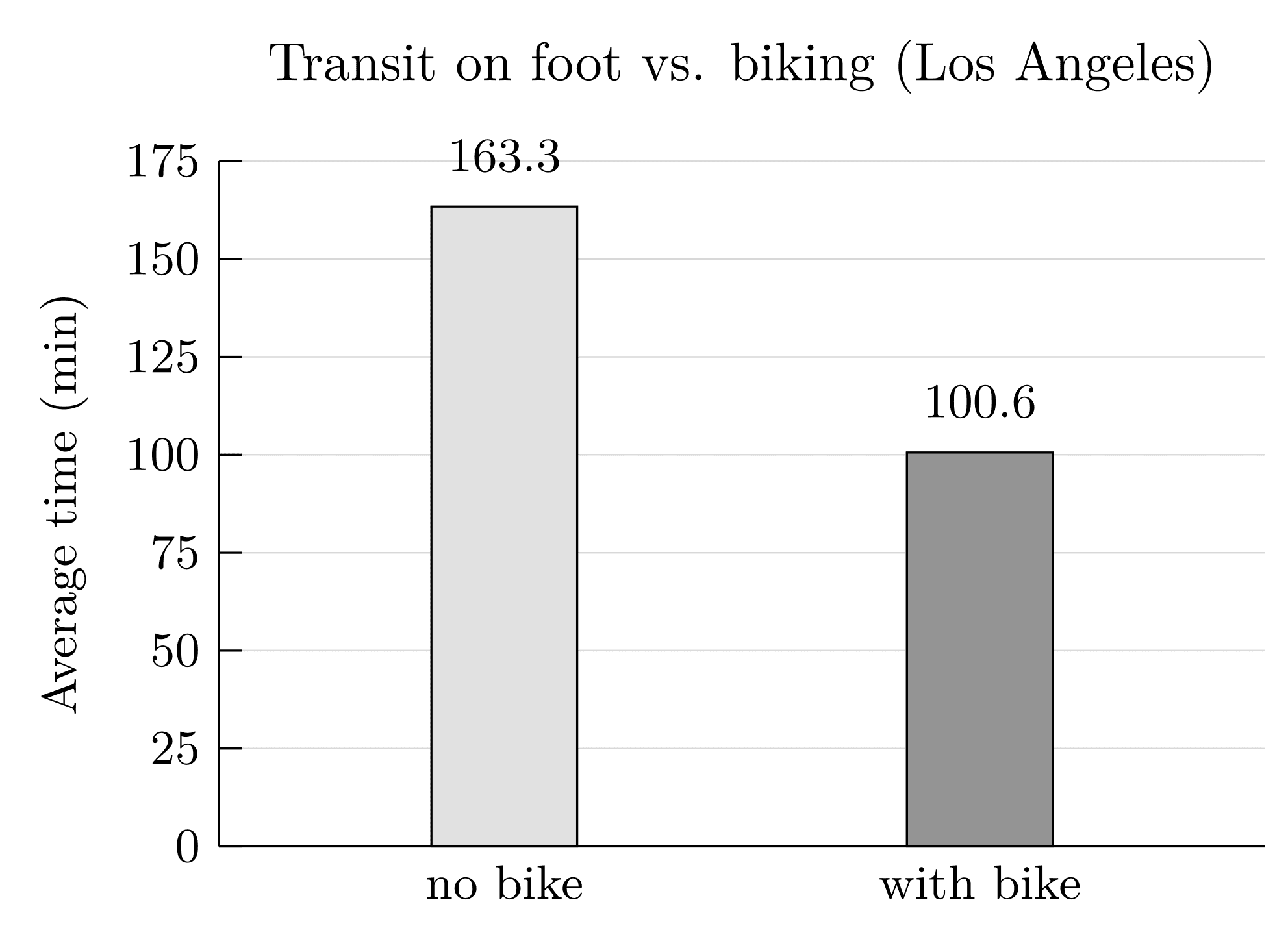
This phenomenon is not specific to the Bay Area. I repeated this experiment in Los Angeles. Biking to transit made car-free travel 62% faster, saving 62 minutes on average.
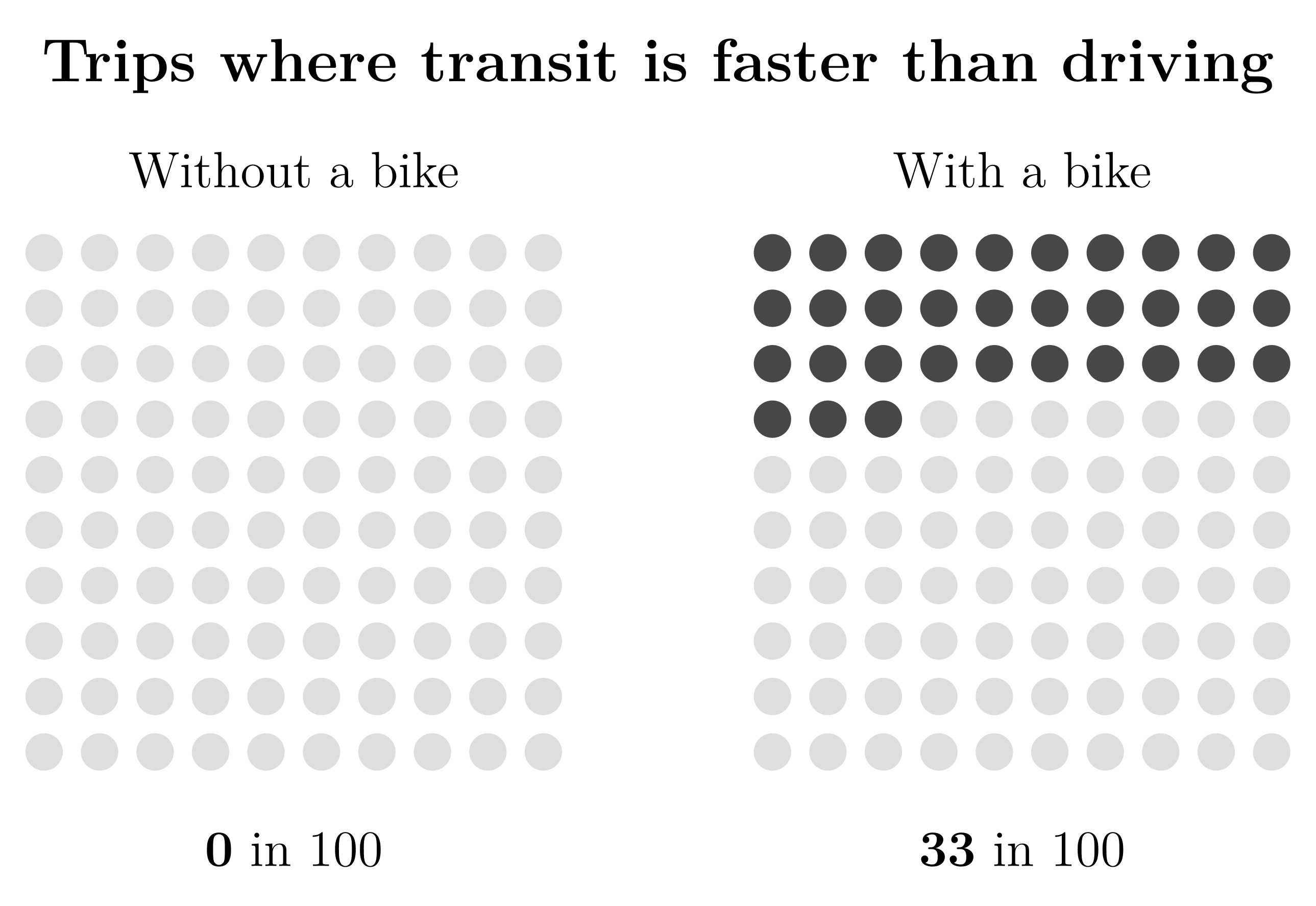
Compare that to driving. The same origin-destination pairs from the Bay Area average 69 minutes by car, departing at the same time. Without a bike, public transit beats driving on none of them. With a bike, it beats driving on a third.
If biking to transit is this much faster, why isn’t it the standard way to ride transit? The first reason is that it is less convenient. Walking out the door requires nothing. A bike has to be maintained, locked, carried, and thought about. I do not dispute this. But the question is what the inconvenience buys. If the bike makes my transit trip 20 minutes faster, that’s worth the hassle. But if it saves me 5 minutes, it’s not. Your number might be different from mine.
The second reason is capacity. A transit vehicle can only hold so many bikes. If too many people bring their bikes, space will be an issue. While a full-size bike suffers from this, compact micromobility such as folding bikes and scooters are immune since they stow to the size of a small suitcase. Bikeshare is also a good option where space onboard transit is limited. Agencies also adapt. BART used to keep bikes out of the first three cars during commute hours; as of 2024 they are allowed in every car but the first8.
The third reason is that most people have never been shown the option. Nearly everyone navigates using Google Maps and Apple Maps, and neither presents bike+transit as a route. You check before a trip and see two numbers: 32 min for driving, and 1 hour 30 min for transit. So you drive. The fastest car-free way to get there was never on the screen. That is why I built Modemix. It shows the fastest car-free route by mixing cycling and transit.
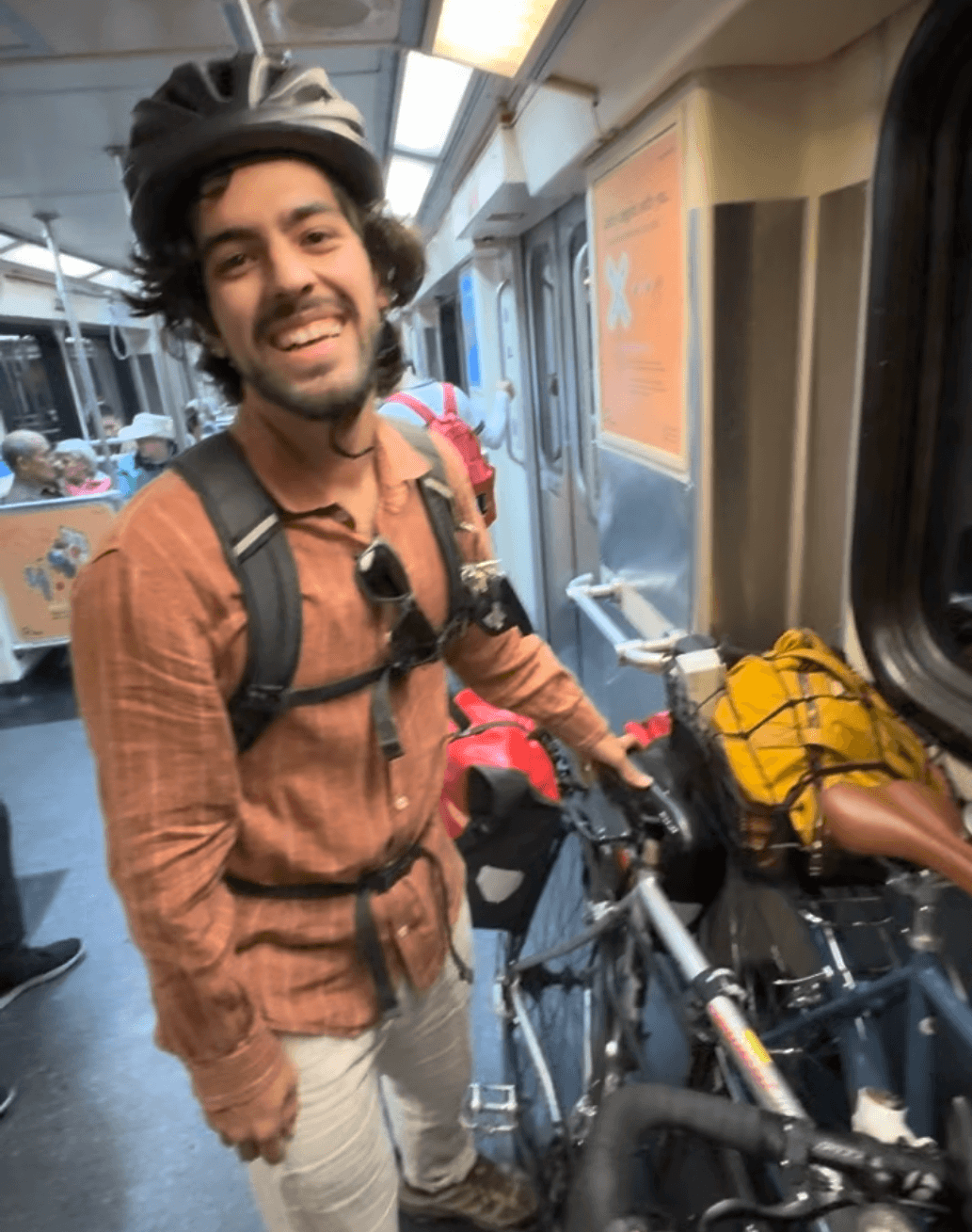
Try it once. Bring your bike on transit and see how it makes you feel. I do it often. It makes me happy.
References
- [1]Selected Economic Characteristics. United States Census Bureau. data.census.gov/table/ACSDP1Y2024.DP03
- [2]New York City DOT, Mobility Report 2018. nyc.gov/html/dot/downloads/pdf/mobility-report-2018-print.pdf
- [3]Wikipedia, New York City Subway. en.wikipedia.org/wiki/New_York_City_Subway
- [4]NYU Wagner School, Commuting to Manhattan: A Study of Residence Location Trends. wagner.nyu.edu/files/faculty/publications/ManhattanCommuting.pdf
- [5]Frank, L., Bradley, M., Kavage, S., Chapman, J., & Lawton, T. K. (2008). Urban form, travel time, and cost relationships with tour complexity and mode choice. Transportation, 35(1), 37-54.
- [6]Liao, Y., Gil, J., Pereira, R.H.M., Yeh, S., & Verendel, V. (2020). "Disparities in travel times between car and transit: Spatiotemporal patterns in cities." Scientific Reports, 10, 4056.
- [7]Metropolitan Transportation Commission, "Commute Mode Choice," Vital Signs, updated March 2026. vitalsigns.mtc.ca.gov/indicators/commute-mode-choice
- [8]BART. "Bike Rules." bart.gov/guide/bikes/rules